Here’s a mistake that happens more often than people admit: someone carefully arranges their wealth corner, adds a jade plant and some coins, then wonders why nothing shifts. Nine times out of ten, they’ve been optimizing for the wrong thing — or only half the picture.
The Feng Shui wealth corner and your personal wealth direction are two completely different concepts. One is tied to a physical location in your home; the other is tied to you. Conflating them is like taking someone else’s prescription — the logic seems right, but the results don’t show up.
The Wealth Corner: Fixed, Universal, Location-Based
The wealth corner comes from the Bagua map, the eight-sector energy blueprint used in classical Feng Shui. The southeast sector governs wealth, abundance, and material prosperity — and it applies to everyone equally, regardless of who lives in the space.
To find it, stand at your front door facing inward, then mentally overlay a 3×3 grid across the floor plan. The far-left zone is your wealth corner. It doesn’t move, doesn’t change with the year, and doesn’t care about your birth date.
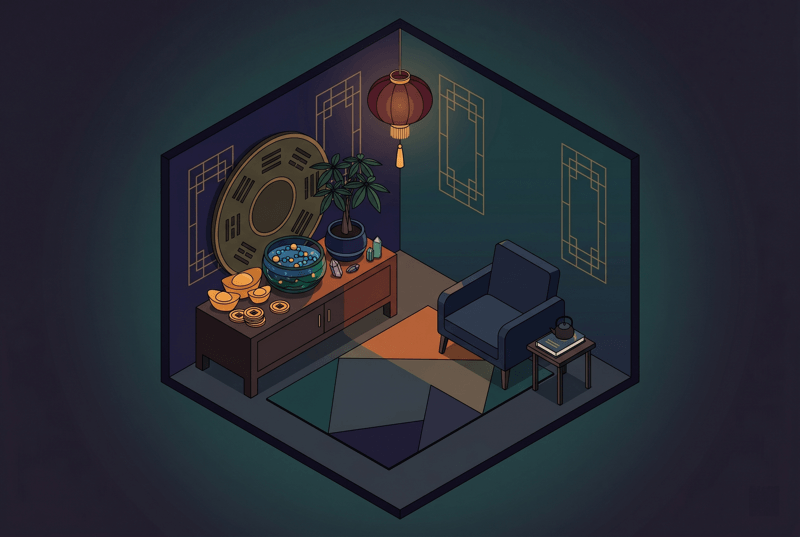
Activating this area usually involves a few well-chosen elements:
- Colors — purple, red, and gold tend to work well here
- Living plants — jade plant or money tree (Pachira aquatica); keep them healthy, not plastic
- Wealth symbols — a laughing Buddha, a wealth ship, or coins tied with red ribbon
- Light and movement — bright natural light is ideal; if not, a full-spectrum lamp does the job
What kills this area faster than anything else is clutter and neglect. A dark, dusty southeast corner quietly works against you even when everything else looks fine.
The Wealth Direction: Personal, Calculated, Compass-Based
This is where things get individual. Your wealth direction isn’t a corner of a room — it’s a specific compass bearing derived from your birth year and gender through the Kua number system (also called Ming Gua, part of the Eight Mansions or Ba Zhai school of Feng Shui).
Two people living in the exact same house can have completely different wealth directions. That’s the whole point — this part of the system is calibrated to you.
When you face your wealth direction — at your desk, during important calls, when negotiating a deal — the idea is that you’re aligning your personal energy with the most supportive flow available to you.
How to Calculate Your Kua Number
The calculation is straightforward:
- Take the last two digits of your birth year and add them until you get a single digit (e.g., 1985 → 8+5 = 13 → 1+3 = 4)
- Males: subtract from 10 → 10 − 4 = 6
- Females: add to 4 → 4 + 4 = 8
- If you land on 5, use 2 (males) or 8 (females) instead
Then match your Kua number to your wealth direction:
| Kua Number | Wealth Direction |
|---|---|
| 1 | South |
| 2 | Northwest |
| 3 | East |
| 4 | Southeast |
| 6 | West |
| 7 | Northeast |
| 8 | Southwest |
| 9 | North |
One note: if you were born before February 4th, use the prior lunar year for your calculation.
The Core Difference
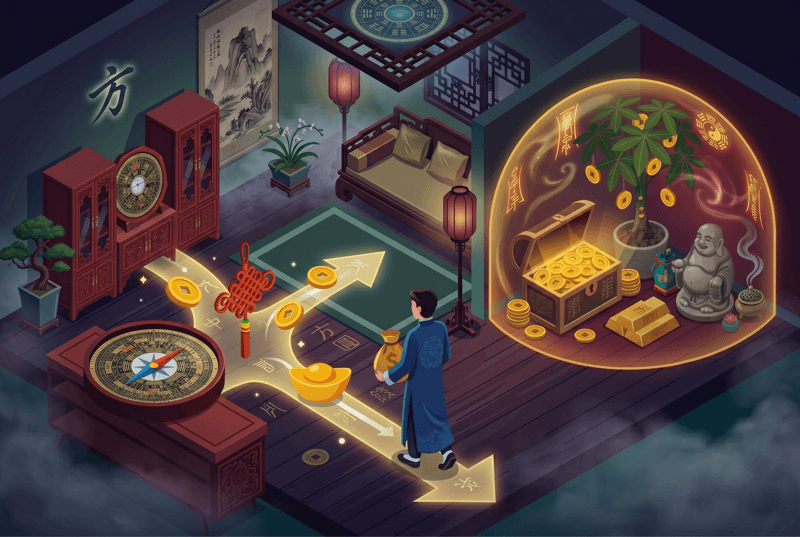
The simplest way to hold both concepts at once — the wealth corner works on the space, while the wealth direction works on you. One is universal, the other is personal. Neither cancels the other out; they’re designed to work together.
If your wealth direction is east but your southeast corner is blocked, stagnant, or full of boxes, you’re only working with half the system. Clear the corner, then orient yourself toward your personal direction. That’s where the two systems compound.
Using Both Together
A practical example: say your desk sits in the southeast corner of your home office, and your Kua number gives you a south wealth direction. Position the desk within that corner and orient it so you face south while sitting. You’re now activating both layers simultaneously.
It doesn’t require a major renovation — a compass app on your phone, a repositioned chair, a cleared shelf. The adjustments are usually small.
Common Mistakes Worth Knowing
A few things consistently undercut both systems:
- Bathroom or trash in the wealth corner — hard to fix architecturally, but you can keep the door closed and add a grounding symbol just outside
- Assuming southeast is your personal wealth direction — it’s often not; Kua 4 is the only number where they overlap
- Fake plants in the wealth area — they look alive but carry no chi, and that contradiction works against what you’re trying to do
- Facing away from your wealth direction during high-stakes moments — a simple habit shift, but most people never bother
Can my wealth direction change over time?
No — it’s fixed by your birth data and doesn’t shift with age or relocation. That said, the annual Flying Stars bring temporary energy overlays to different sectors each year, so specific directions may get a boost in certain years even if they’re not your permanent wealth direction.
What if my wealth direction faces a wall or points outside the building?
You still benefit from facing that direction, even without a window or clear view. Use a compass app to orient your chair or body toward that bearing during work or important decisions. The direction itself carries the influence, not what’s physically in front of you.
Is the southeast corner always the wealth corner?
In the traditional eight-life aspirations system, yes. Some modern practitioners use the “entrance-facing” method from the Black Hat school of Feng Shui, which can place the wealth corner elsewhere depending on the front door position. If you’re using two different resources and getting contradictory results, that’s likely why — they’re drawing from different schools.
✦ Personalized Report
Ready to find your exact wealth position?
This article covers general principles. Your home has its own Flying Stars chart that determines exactly where your wealth position sits.
From $39 · PDF in 3–5 days